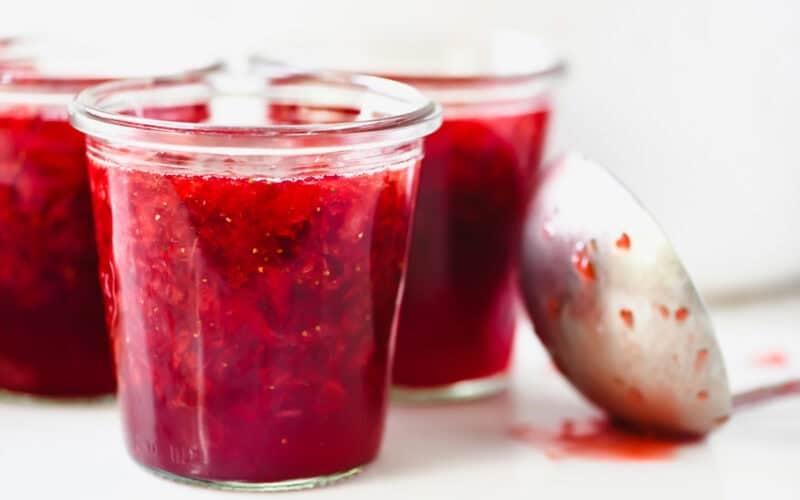

This classic Sure-Jell strawberry jam recipe comes straight from the pectin box ~ it’s a foolproof, old-fashioned jam you can water bath can, refrigerate, or freeze, with bright strawberry flavor and a perfect set every time.

Sure-Jell Strawberry Jam Recipe (Classic + Foolproof)
If you’ve ever made homemade jam, chances are you’ve used Sure-Jell. It’s the most widely available fruit pectin, and the recipe on the back of the box has become the gold standard for classic strawberry jam. This version gives you a bright, sweet flavor and that familiar, firmly set texture that works beautifully for spreading, baking, and gifting. Best of all, you can water bath can it for shelf storage, or keep it simple and refrigerate or freeze.
Sure jell strawberry jam is perfect for:
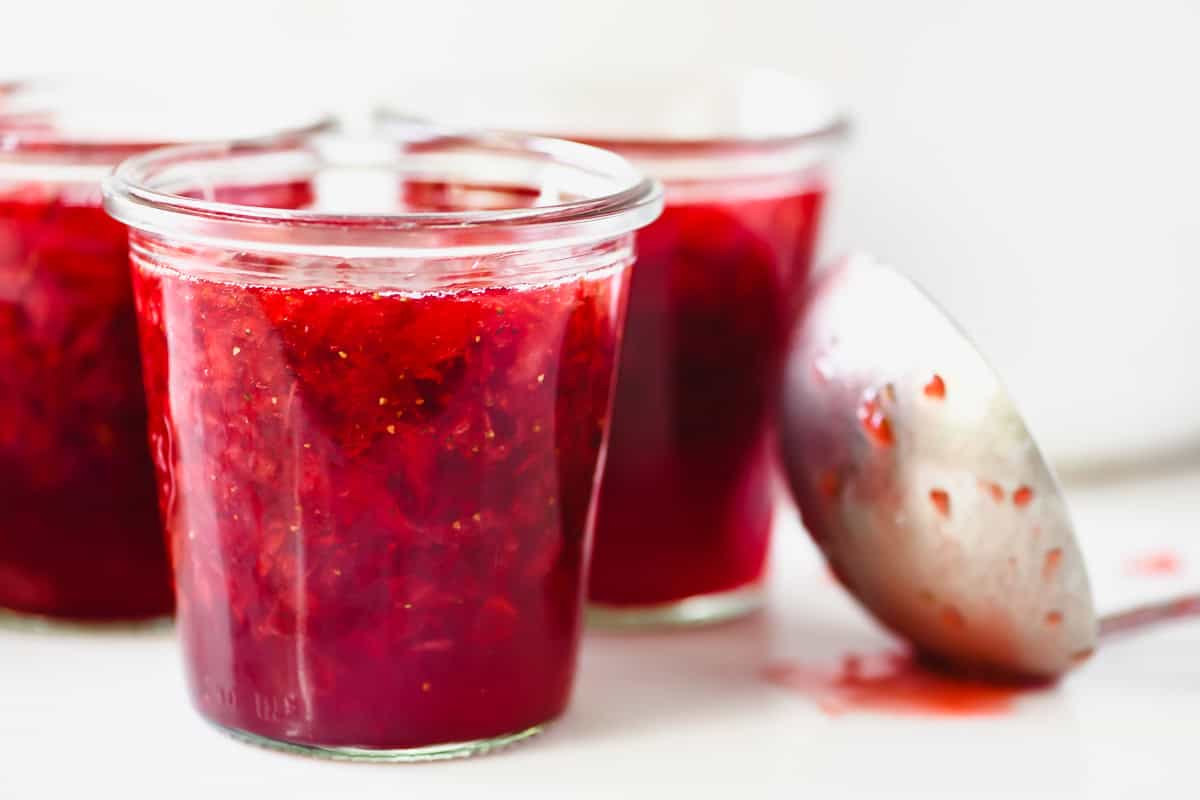
Just 3 ingredients for Sure-Jell strawberry jam!
- strawberries (fresh or frozen ~ both work well)
- granulated sugar
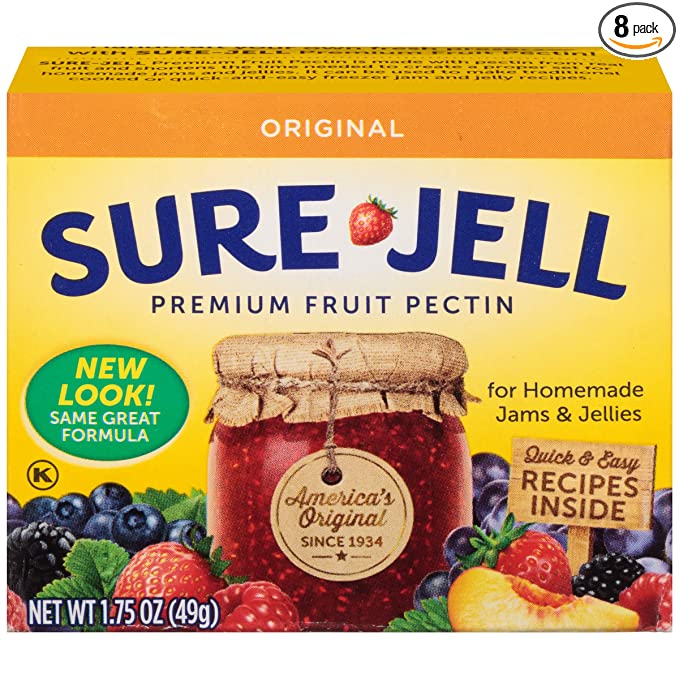
- Sure-Jell powdered fruit pectin (the yellow box)

Let’s make it, step by step
The instructions for the Sure-Jell strawberry jam recipe on the box can feel confusing at first glance ~ here’s the clear, step-by-step method that works every time.
- Rinse, hull, and crush your strawberries (a food processor works well, just don’t purée completely). Measure exactly.
- Add the crushed berries to a large, heavy pot and stir in the pectin.
- Bring the mixture to a full rolling boil over high heat (a boil that can’t be stirred down).
- Add all the sugar at once and stir well.
- Return to a full rolling boil and boil hard for exactly 1 minute, stirring constantly.
- Remove from the heat and skim off any foam.
- Ladle into clean jars.
- Either process in a water bath for shelf storage, or let cool and refrigerate or freeze.

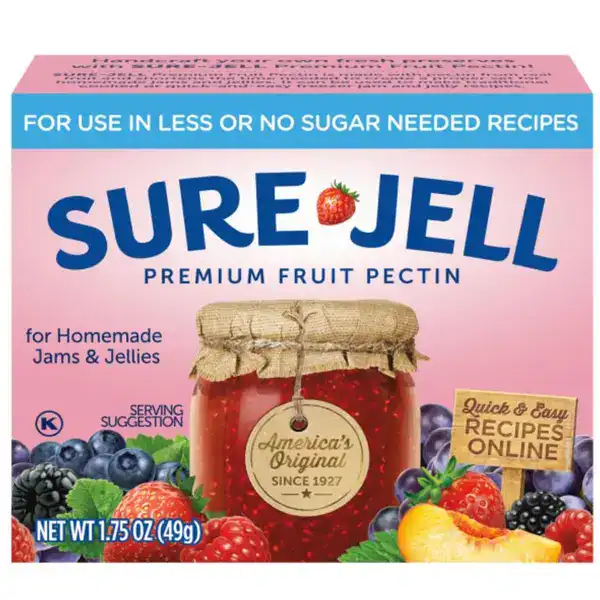
What’s the Difference Between the Yellow and Pink Sure-Jell Boxes?
This recipe uses the original Sure-Jell (yellow box), which is designed for classic, full-sugar jams with a firm set. It relies on sugar to activate the pectin and create that traditional texture.
The pink box (Sure-Jell “less or no sugar needed”) works differently ~ it’s made for low-sugar or no-sugar jams and uses a different method entirely (you cook the pectin separately and stir in the fruit later). The two are not interchangeable, so always match your recipe to the box.
tips and faqs about Sure-Jell strawberry jam
Sure-Jell is a commercial pectin made with sugar (dextrose) citric acid, and fruit pectin. The pectin is derived from citrus fruit. This recipe is made with the original formula (in the yellow box.) If you want a classic, sweet, firmly set jam, this is your pectin.
This recipe uses traditional (high methoxyl) pectin, which requires sugar to form a proper gel. The sugar isn’t just for sweetness ~ it’s essential for structure. If you want a lower sugar option, you’ll need to use the pink box version of Sure-Jell designed for that purpose.
Yes, just be sure to leave 1/2 inch free space at the top to allow for expansion as it freezes.
Yes, you can cook the jam down for a longer time until it thickens naturally through evaporation of the water. This could take 40-50+ minutes, depending on your fruit.
If you simply refrigerate the jam it will last up to a month. If you freeze it it will be good for 6 months, and if you can it, it will last a year.
Pectin recipes like this are calibrated for a very specific ratio of fruit, sugar, acid, and heat. When you double the batch the result is jam that’s runny, uneven, or unpredictable. Best to make 2 batches.
For best results, it’s important to stick to the exact fruit and measurements in this recipe. Classic Sure-Jell (yellow box) recipes are carefully balanced for a proper set, and changing the type or amount of fruit can affect both the texture and the final result.
If you’d like to experiment with mixed fruits, it’s best to treat the jam as a refrigerator or freezer jam rather than canning it.
 Add The View from Great Island as a Trusted Google Source

Strawberry Jam
Ingredients
- 5 cups crushed strawberries, measured after crushing (you'll need about 3 lbs fresh, whole berries to start with)
- 1 package SureJell powdered fruit pectin (in the 1.75 oz yellow box.), find it here.
- 7 cups white sugar
Instructions
- Measure out your ingredients and have your clean jars at the ready for filling with jam.
- Place the crushed berries* in a large, tall heavy bottomed pot (the mixture will rise as it boils so you want to make sure you have plenty of extra room in your pot), and stir in the whole package of pectin.
- Over medium-high heat, bring the mixture to a rolling boil. Note: a rolling boil is a boil that you can't stir down. This will take a few minutes or more, depending on your fruit, your pot, and the heat of your stove.
- Add the sugar and stir thoroughly. Bring the mixture back up to a rolling boil, and then continue to boil for exactly 1 minute. Continue stirring the whole time.
- Remove the jam from the heat, and skim off any foam with a spoon.
- Fill your jars with the hot jam and allow to cool at room temperature. Note: your jam will be quite liquid at this point, and that's normal. The pectin won't solidfy until the jam chills.
- Store in the fridge for up to a month, the freezer for up to 6 months, or follow instructions for water bath canning, if desired.
for water bath canning
- (If you are new to canning, make sure you've read the full details from a source you trust, I like the instructions from Ball.) Ladle the hot jam into hot jars, and leave 1/4 inch at the top. Wipe any drips off the rims with a clean cloth. Cover each jar with a clean lid, and screw to finger tight. Place jars on a rack in your canner. Be sure the water covers the jars by 1 to 2 inches. Cover the pot and bring water back to a boil. Process the jam for 10 minutes. Carefully take out the hot jars and put them on a kitchen towel to cool. After cooling, check seals on the jars. If any of the jars have not sealed properly, refrigerate them and consume within a month.
Notes
- *To crush strawberries, first rinse and hull your berries. Then cut them in halves or quarters. Puree them in a food processor, blender, or with an immersion blender until they are blended fairly smoothly, but still retaining some texture.
- Recipe is from the Sure-Jell pectin package.
Nutrition
Jam Troubleshooting Guide ~ Fixing Common Problems
Why is my strawberry jam runny?
Runny jam is by far the most common problem, and it usually comes down to one of a few things: the fruit wasn’t measured exactly, the mixture never reached a true rolling boil, or the jam wasn’t boiled for the full minute after the sugar was added.
With this type of pectin, “rolling boil” means a vigorous boil that cannot be stirred down. A gentle simmer won’t activate the pectin properly. It also matters that you boil for the full minute after the sugar goes in, not before.
Another common issue is watery fruit. Strawberries can vary a lot in juiciness, so measuring the crushed berries accurately is important.
How to prevent it next time:
Measure the crushed fruit exactly, use high heat to reach a full rolling boil, and set a timer for the final 1-minute boil.
Can it be fixed?
Sometimes a slightly loose jam will firm up more as it cools completely, especially after 24 hours. If it’s still too loose, it’s best to refrigerate it and use it as a softer jam, spoon over yogurt or ice cream, or try a small re-cook following approved pectin directions.
Why is my jam too thick?
A jam that turns overly thick, rubbery, or dense is usually the result of overboiling. Once the sugar is added, the final hard boil should last only 1 minute. Longer than that, and you risk driving off too much moisture or weakening the texture.
Too much pectin or too little fruit can also throw off the balance and create a jam that sets harder than it should.
How to prevent it next time:
Use exact measurements and a timer. Jam moves fast once it reaches the boil, so this is not the moment to estimate.
Can it be fixed?
If the jam is already jarred and set, there’s not much you can do to restore the original texture, but it’s still perfectly usable. Warm it gently and use it as a glaze, stir it into oatmeal, or melt it into a pan sauce or dessert topping.
Why didn’t my jam set?
This is often a timing or heat issue, not necessarily a recipe failure. The boil may not have been hot enough, the sugar may not have dissolved evenly, or the fruit-to-sugar-to-pectin ratio may have shifted slightly.
It can also happen if the jam is doubled. Pectin recipes like this one are designed to work in a very specific volume, and increasing the batch size can make it much harder to get the same reliable set.
How to prevent it next time:
Make one batch at a time, use a wide heavy pot, and avoid making casual substitutions.
Classic Sure-Jell recipes are not flexible. If you want to reduce the sugar, switch fruits, or experiment, start with a recipe designed for that variation.
Why is my jam foamy?
Foam is completely normal in strawberry jam. It happens because boiling fruit and sugar traps air at the surface. It doesn’t mean anything is wrong, and it doesn’t affect safety, but it can make your finished jars look cloudy or uneven.
What to do:
Skim off the foam right after removing the pot from the heat. A shallow spoon works well.
Why does my jam taste too sweet?
That’s the nature of this old-fashioned yellow box recipe ~ it’s a classic full-sugar jam, and the sugar is part of how the pectin sets. If readers want a fresher, tarter, less sweet result, they’ll probably be happier with a low-sugar pectin recipe instead of trying to force this one to behave differently.
Good line for your voice:
This recipe is for a classic sweet jam, not a modern low-sugar preserve.
Can I reduce the sugar in this recipe?
Not with the yellow box recipe. This version depends on a full sugar ratio for a proper set. If you cut the sugar, the jam may turn out loose, syrupy, or unpredictable. For lower sugar strawberry jam, use the pink box Sure-Jell made specifically for that purpose.
For less sugar try my uber simple microwave jam, which is basically fruit, microwaved down to its bubbly essence. My Belgian friend Elisa showed me how to make her family’s strawberry jam the European style, which is wonderful but doesn’t jive with American safety standards. There’s no doubt about it, the world of jam making is complex and fraught with pitfalls. That’s why I often default to small batch refrigerator jams so I can play with flavors and ingredients without worrying about safety concerns.


Oh my goodness…..I followed the recipe on the sure gel box and I was confused and now realized I did it completely wrong according to your tips and recipe. The box does not make it clear to mix sugar & berries on the stove top with the sure gel & water. It explains to mix them separately I thought. So now my dilemma is can I thaw out a container and heat it on the stove top to melt the sugar more or are all my containers now trash. Oh I’m so aggravated! Wish I would have seen your post before I started!!
That’s exactly why I wrote this post, the directions are crazy confusing!